Crosswind Calculator
Calculate crosswind and headwind components for aviation or other applications
Results
Crosswind Component
0 kts
Headwind Component
0 kts
Wind Angle
0°
How to Use This Calculator
Enter Wind Direction
Input the direction the wind is coming from in degrees (0-360). For example, 270° means wind from the west.
Enter Wind Speed
Input the wind speed and select your preferred unit (knots, mph, km/h, or m/s).
Enter Runway Heading
Input the runway heading in degrees (0-360). For example, 090° points to the east.
Calculate
Click the “Calculate Crosswind” button to see your crosswind and headwind components.
This tool helps pilots determine the crosswind and headwind components when landing or taking off.
Crosswind is the wind component perpendicular to the runway, while headwind is parallel to the runway.
Crosswind Calculator – Simple Calculation for Safe Flying
Flying is a fascinating experience, but every pilot knows that safety comes first. An essential factor for safety in aviation is knowing the wind conditions – especially at the time of landing and takeoff. It helps pilots calculate the crosswind and headwind components of the wind, enabling them to make informed decisions about whether to continue the flight safely.
This article explains in detail what a crosswind calculator is, how it works, how pilots use it, and why it is essential in aviation. Finally, you will also find a Frequently Asked Questions (FAQ) section that will clear up your most common doubts.
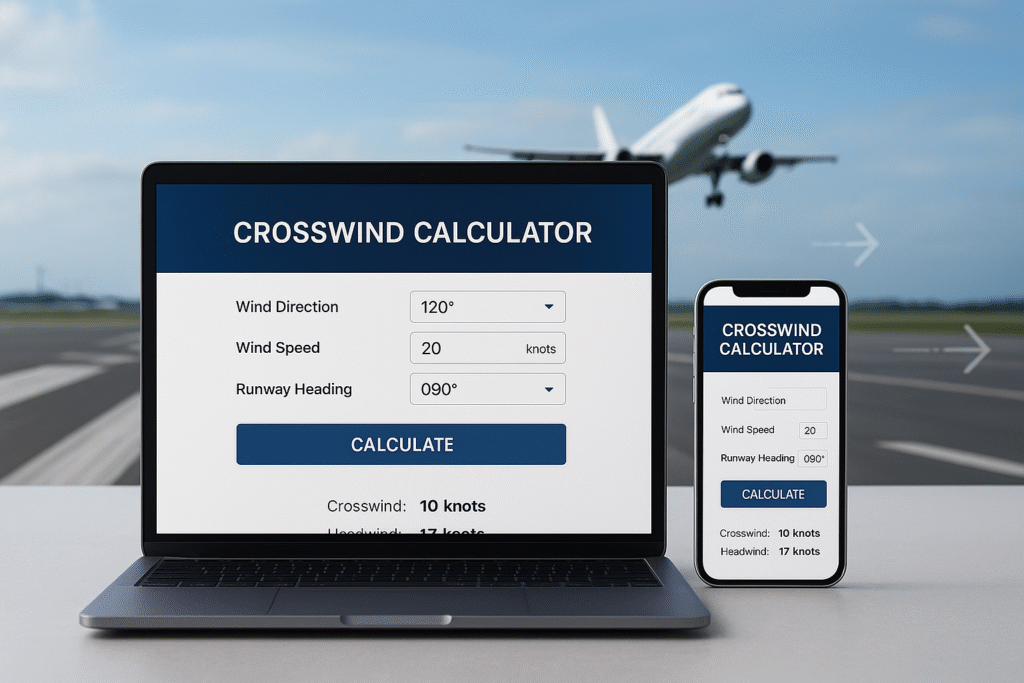
Table of Contents
- What is a Crosswind Calculator?
- Why is the Crosswind Calculator Important?
- How Does a Crosswind Calculator Work?
- Types of Crosswind Calculators
- Advantages of the Online Crosswind Calculator
- When Should You Use a Crosswind Calculator?
- Crosswind Calculator and Pilot Training
- How Do Pilots Deal With Crosswinds?
- Crosswind Limits
- Our Online Crosswind Calculator
- FAQs – Crosswind Calculator
- Conclusion
What is a Crosswind Calculator?
The crosswind calculator is a tool that calculates two components of the wind:
- Crosswind component
- Headwind/tailwind component
An example: If the wind is coming at a speed of 20 knots and is blowing at a 45° angle to the runway, the crosswind calculator will tell you exactly how much wind is coming in the form of a crosswind and how much is coming in the form of a headwind.
This is important because every aircraft has a maximum crosswind limit. If the wind exceeds this limit, landing or takeoff becomes risky.
Why is the Crosswind Calculator Important?
Pilots need to understand the wind. Here are some reasons why:
Safe landing and takeoff
Crosswinds can push aeroplanes off the runway. Pilots use the calculator to ensure a safe landing.
Limits for aeroplanes
Every aircraft manufacturer specifies a limit value. The crosswind calculator helps pilots to comply with this limit.
Training and practice
Student pilots use the calculator during training to understand different conditions.
Precise flight planning
Before the flight, pilots also plan alternative airports where the wind conditions are better.
How Does a Crosswind Calculator Work?
It is a simple trigonometric calculation that breaks down wind speed and direction into two parts:
- Headwind/tailwind – which occurs directly along the runway.
- Crosswind – which affects the runway from the side.
Formula:
- Crosswind = wind speed × sin(angle difference)
- Headwind = wind speed × cos(angle difference)
Example:
- Direction of the runway: 090°
- Wind direction: 120°
- Wind speed: 20 knots
Angle difference = 120° – 90° = 30°
Crosswind = 20 × sin(30°) = 10 knots
Headwind = 20 × cos(30°) ≈ 17 knots
The Matlab pilot found that there was a crosswind of 10 knots and a headwind of 17 knots.
Types of Crosswind Calculators
- Manual crosswind chart – Old-style pilots use charts.
- Mathematical formula – For manual calculation with trigonometry.
- Apps and avionics systems – Modern aeroplanes have built-in calculators.
Advantages of the Online Crosswind Calculator
- Instant results – Accurate calculation in seconds.
- Error-free – Manual errors are avoided.
- User-friendly – Only three inputs: Wind speed, direction, slope heading.
- Free access – Online calculators are easily accessible.
When Should You Use the Crosswind Calculator?
Pilots use this tool in every critical phase:
- Before landing – to choose a safe runway.
- During training, students practice how the wind will affect them.
- Flight planning – helps to select alternate airports.
Crosswind Calculator and Pilot Training
Crosswinds are not easy for student pilots. With the calculator, they learn what effects different wind conditions have. This boosts their self-confidence and enables them to make better decisions.
How Do Pilots Deal With Crosswinds?
Even after the calculation, the pilot must use the correct flying techniques:
- Crab method – The nose is set against the wind and aligned with the runway at the last moment.
- Wing-low method – One wing is tilted to the windward side, and the opposite rudder is used.
- Combination method – A mixture of both techniques.
Crosswind Limits
The limits vary depending on the type of aircraft:
- Small trainer aircraft (Cessna 172) – 15 knots
- Regional jets – 25–30 knots
- Commercial aircraft – 35–40 knots
Therefore, every pilot must use a crosswind calculator to ensure that they comply with these limits.
Our Online Crosswind Calculator
The crosswind calculator on our website offers you:
- Instant and accurate results
- Simple interface
- Free to use
- Trigonometric accuracy
Bookmark this page and make it part of your flight planning.
FAQs – Crosswind Calculator
Q1. What is the crosswind calculator for?
This tool shows the pilot how much wind there is in the form of crosswind and headwind.
Q2. How is the manual calculation performed?
Crosswind = Wind speed × sin(angle), headwind = Wind speed × cos(angle).
Q3. Do pilots use this method?
Yes, both the professional pilots and student pilots use it regularly as per their convenience.
Q4. What is the maximum crosswind limit?
Depends on the type of aircraft – small aircraft up to 15 knots and large commercial aircraft up to 40 knots.
Q5. Is the online crosswind calculator free of charge?
Yes, our tool is 100% free of charge.
Q6. Is this useful for student pilots?
It helps them in decision-making and practice.
Q7. When should it be used?
It is best to check the crosswind before every takeoff and landing.
Conclusion – Why Every Pilot Should Use a Crosswind Calculator
The crosswind calculator is a simple but powerful tool for aviation. Whether you are a student pilot or an experienced aviator, understanding crosswind and headwind components is very important.
With our online crosswind calculator, you'll get accurate results instantly, stay within aircraft limits, and make flying safer.
Safe flying is always the result of thoughtful preparation – and the crosswind calculator is your reliable partner in the sky.
