Boat Floating Calculator
Calculate buoyancy force and determine if your boat will float
Input Parameters
Typical wood density: 500-800 kg/m³
Fresh water: 1000 kg/m³, Sea water: ~1025 kg/m³
Visualization
Calculation Results
Buoyancy Force
0 N
Boat Weight
0 N
Status
Will it float?
How to Use This Calculator
Enter Parameters
Fill in the details about your boat material, volume, water type, and load.
Calculate
Click the calculate button to see the buoyancy force and boat weight.
Interpret Results
See if your boat will float and adjust parameters as needed.
Understanding Buoyancy
Buoyancy is the upward force exerted by a fluid that opposes the weight of an immersed object. According to Archimedes’ principle, the buoyant force is equal to the weight of the fluid displaced by the object.
For a boat to float, the buoyant force must be greater than or equal to the total weight of the boat plus its load.
Boat Floating Calculator – Determining the Buoyancy and Stability of Your Boat
As with any boat or ship, one of the most relevant factors is buoyancy, which basically means whether the boat will float or not. A Boat Floating Calculator is the best solution for such problems.
The tool will help you determine whether the boat will sink or float, what the optimal load is, and what the optimal weight for the boat to float at a certain water level is.
In this article, let’s discuss what a boat floating calculator is, its benefits, and how it helps out.
What is a Boat Floating Calculator?
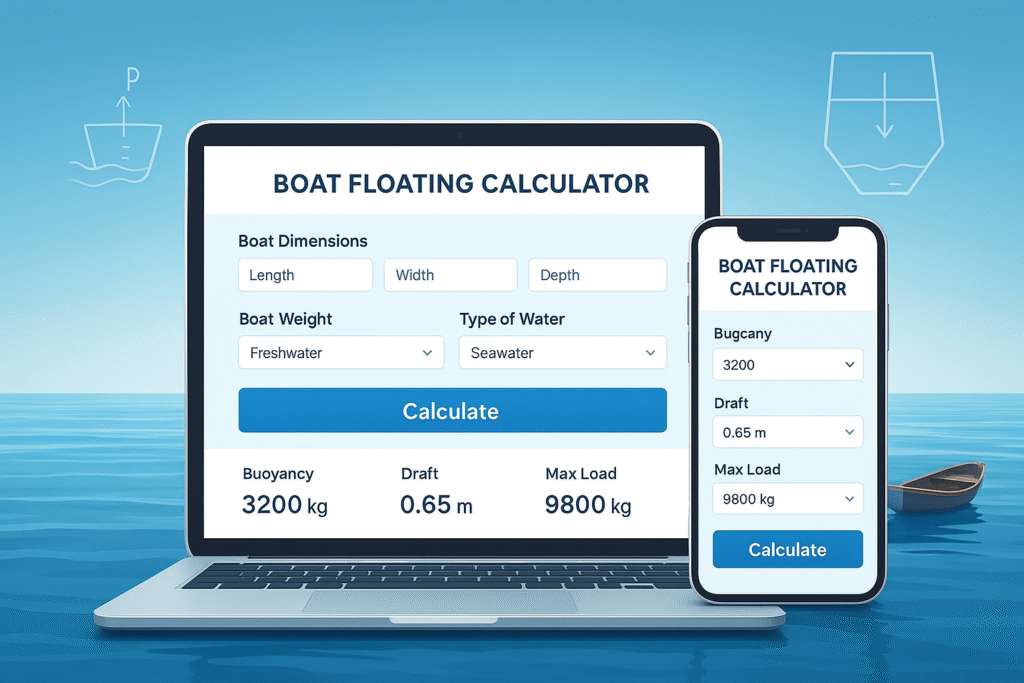
In the simplest terms, a boat floating calculator is a tool, either online or software-based, which calculates boat buoyancy, displacement, and stability.
The inputs required by this tool are
- Weight of vessel
- Boat measurements (length, width, depth)
- Type of water (freshwater or seawater)
- Additional Load or cargo (passengers, fuel, etc.)
The provided outputs are:
- Assessment of vessel flotation or submersion
- Degree of submersion or boat draft
- Maximum Permissible Load
This is why the tool is particularly helpful for students, engineers, and boating enthusiasts.
Importance of a Boat Floating Calculator
As with any scientific approach, there is a certain logic behind boating: Archimedes’ Principle. The principle states that for any body that is floating, there is always a certain amount of water that is displaced. In simple terms, the boat should float in water only if the vessel stands still with the buoy.
The problem is that doing all this in calculations can be tedious, which is why the Boat floating calculator is helpful.
Benefits of a Boat Floating Calculator
- Time efficient, no tension of doing calculations by hand
- Provides instantaneous precision
- Assists in the construction of a balanced boat
- Applicable for both freshwater and seawater
How Does a Boat Floating Calculator Work?
The Boat Floating Calculator focuses on Archimedes’ Principle for its functions.
Formula:
Buoyant Force = Weight of Displaced Water
A Matlab boat will float only if:
Boat Weight + Load ≤ Buoyant Force
Based on your inputs, the calculator tells you immediately if:
- The Boat will float or sink
- The draft of the Boat
- The maximum Load of the Boat
Example – Boat Flotation Calculator Usage
Consider a wooden boat with the following measurements:
- Length = 4 m
- Width = 2 m
- Depth = 0.5m
- Weight of the Boat = 200 kg
- Weight of the load = 300 kg
- Density of fresh water = 1000 kg/m²
Calculating the Volume of the Boat.
V = L × W × D = 4 × 2 × 0.5 = 4 m³
Step 2: Calculating the maximum displaced freshwater:
Max displaced water = V × freshwater density = 4 × 1000 = 4000 kg
Step 3: Calculating total load.
Total load = weight of the boat + weight of the load = 200 + 300 = 500 kg
Result: 500 kg < 4000 kg, so the boat will float effortlessly.
The boat flotation calculator performs all the calculations automatically and instantly tells you the results.
Boat Floating Calculator Features
- Mobile and desktop compatibility
- User-friendly navigational steps
- Calculates for both freshwater and seawater
- Derivation and estimation for buoyancy, draft, and load capacity
- Accurate instant results
- Accessible online without cost
Boat Floating Calculator Uses
The following people can use this tool effectively, and while professionals can, everyone can benefit as well.
- Learners: for demonstrating and executing physics experiments and learning Archimedes’ Principle.
- Recreational and Commercial Ship Builders: for producing safe and stable designs.
- Fishermen: for verifying safe working load limits.
- Casual Boat users: for preventive measures against overloaded boats, canoes, and kayaks.
- Marine Technicians: for assessment and evaluation of designs before actual vessel deployment.
Boat Floating Calculator vs. Manual Calculations
When done manually, buoyancy calculations can be labor-intensive and time-consuming. Often, applicants struggle to recall specific formulae and their values while systematically executing step-by-step results.
With a calculator, problems are easily dealt with. Simply input values, and results are computed. In addition, numerous scenarios can be tested for instant calculations.
Steps for using a Boat Floating Calculator
- Open the calculator
- Enter the dimensions of the boat.
- Enter the weight of the boat.
- Enter the weight of the cargo or load.
- Select either freshwater or seawater
- Click the “Calculate” button
- Results will display almost instantly
Safe Boating Tips with Boat Floating Calculator
- It is vital to ensure calculations are made before the addition of more weight
- Ensure the Load is balanced
- Boats float more in seawater (density is high)
- Staying around 10-15% below the maximum limit is safer
- Weigh the Boat occasionally (wood might absorb water and increase weight)
Real-Life Example – Fisherman’s Boat
A fisherman’s boat weighs 250 kg, and he wants to load 400 kg of fish and equipment.
After working with the calculator:
- Boat volume: 3 m³ (3000 kg of water can be displaced)
- Total Load is 250 kg boat plus 400 kg fish = 650 kg
Results of the calculations demonstrate that the boat can carry the load.
A fisherman can easily overload or underload the boat. Risk can be reduced by using floating calculators.
What makes the Online Boat Floating Calculator unique?
- No complex calculations to memorize
- Compatible with phones and computers
- Can be used from any location
- Intuitive, so even non-specialists can use it easily
- No payment required
FAQs – Boat Floating Calculator
Q1. What is a boat floating calculator?
It is a web-based application that computes a boat’s buoyancy, draft, and load capacity.
Q2. How does it work?
It computes buoyancy using Archimedes’ Principle—weight of displaced water = buoyant force.
Q3. Is it applicable to both freshwater and seawater?
Yes, you can select the water type.
Q4. Is it free?
Yes, most boat floating calculators are free.
Q5. Can students access it?
Yes, it is beneficial for students, especially those studying physics.
Q6. Is it reliable?
Yes, as long as the input values are correct, it is reliable.
Conclusion—What are the use cases for the Boat Floating Calculator?
For boating, fishing, or boat designing, the boat floating calculator is an indispensable tool. It provides an estimation of the boat’s safety, the load capacity, and stability in water within seconds.
This tool ensures safe boating for everyone, including students, fishermen, and marine engineers. It minimizes time, effort, and risk.
